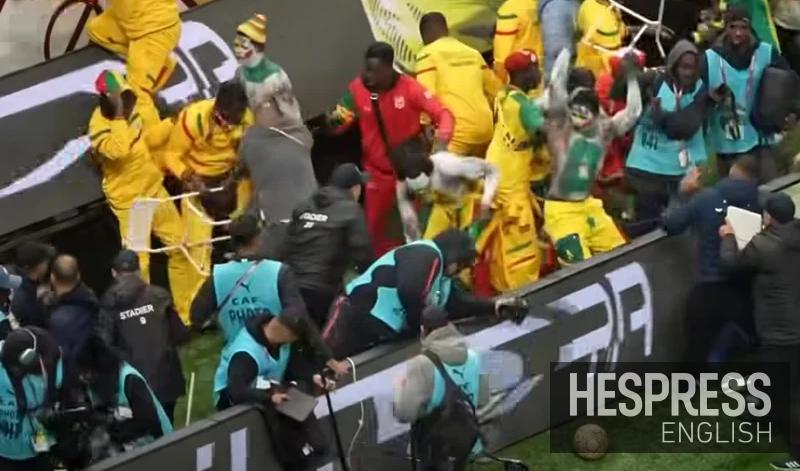
CAF’s suspensions and heavy fines on Morocco over the AFCON final in Rabat sparked widespread criticism on social media, “as many saw the sanctions as unfair,” and expected harsher penalties for Senegal, with their coach and players leaving the pitch and fans causing chaos in the stands.
CAF’s disciplinary committee also rejected the Royal Moroccan Football Federation’s complaint against Senegal, which asked for additional sanctions for violating Articles 82 and 84 of the Africa Cup of Nations rules.
“CAF’s sanctions are a joke,” said Mohammed Ammor on X, adding, “we weren’t expecting a replay like so many fools did three years ago, and none of us staged a protest in Zurich outside FIFA’s headquarters.
He stressed, “we didn’t want that, nor should we have. But a coach walks out of an Africa Cup final and gets a five-match ban, while a player, running after a towel, is suspended for three matches.”
“CAF’s sanctions have become a joke and lost credibility, taking away much of the value and excitement from continental competitions,” said another one.
Sports experts say CAF’s disciplinary sanctions against Senegal and Morocco could encourage other teams to walk off in important matches or create chaos when unhappy with refereeing, damaging African football’s reputation.
Coach and sports expert Moustapha Al Harhar criticized the sanctions as weak, saying they do not reflect Senegal’s violations, and noted that CAF’s decisions are predictable due to a lack of fairness in previous cases.
He stressed that the penalty was correct and the whistle was blown before the disallowed goal, adding that Morocco’s players and federation acted properly and performed impressively in a difficult match.
Al Harhar called for more professionalism in the future, noting that Morocco’s success in organization, infrastructure, and sporting results always draws scrutiny.
He urged moving away from excuses, like magic or weak justifications, and focusing on contracts and regulations to ensure African football develops properly, while also changing how Morocco deals with continental football.
Sports analyst Aziz Belghiti also called CAF’s sanctions predictable and weak, reflecting corruption within the system, and said “they fail to uphold African football’s reputation, especially with the tournament serving as preparation for the 2030 World Cup.”
He called for a complete restructuring of CAF with professional staff and new elections, criticizing what he called “ignorant lobbies controlling African football decisions.
Belghiti also said Morocco should reclaim the title under Article 82, which states that a team leaving the pitch without the referee’s permission should be disqualified and considered the loser.
Some netizens even urged the Royal Moroccan Football Federation to appeal CAF’s decision.
“The Royal Moroccan Football Federation must act immediately, file an appeal, and take the case to the Court of Arbitration for Sport (CAS) in Lausanne, since CAF cannot act as both judge and party,” said an X user.
The user described CAF’s sanctions as “a clear legalization of chaos,” saying that rewarding a team with a confirmed title and symbolic fines after a walkout signals the death of sportsmanship in African football.”
By these sanctions, the user said that “CAF is encouraging walkouts, treating Morocco, the victim, the same as the team that stopped the match, and showing no deterrence by suspending a coach for just five matches after a dramatic walkout.”
“CAF’s fines, totaling $715,000 for Senegal, represent only about 10% of what their team earned in this edition of the tournament ($7 million), and this sanction could encourage more walkouts and crowd disturbances in the future,” warned a user on X.
Senegal coach Pape Thiaw was suspended for five matches and fined $100,000, players Iliman Ndiaye and Ismaila Sarr were banned for two matches each, and the federation was fined $615,000 over supporter misconduct and team behavior, which damaged the game’s image and violated fair play and integrity.
Morocco, on the other hand, had Achraf Hakimi suspended for two CAF matches, one suspended for a year, Ismael Saibari banned for three matches and fined $100,000, and the federation fined $315,000 for misconduct involving players, staff, and matchday operations, including interference with ball kids.
Rephrase in a different way as if you were a native American speaker as a content creation expert and do not talk about yourself or your experience in the text and do not show yourself as an artificial intelligence who wrote and fill the bullet point in the topic and speak the heart of the topic itself and dont take date of blog in ther first and dont take text like box of newsliter subscribe on post from content and romove all linke insert in content and and remove all affiliate disclosure phrases on content like this “This post may contain Amazon or other affiliate links that allow us to earn a small commission at no extra cost to you. Please see our Disclosure Policy for more info” and “#” put in its place bullet point, and romove name of the web site or his links we are take a content from our new creation, and don’t publish clone new content more than just one time