You can ride a driverless taxi in Dubai right now. The service runs in Jumeirah and Umm Suqeim, and you book it either through Apollo Go’s own app, which has been carrying passengers at no charge in the pilot area, or by picking the autonomous option inside the Uber app. Both put you in the same car with nobody in the driver’s seat.
Search driverless taxi Dubai and nearly every result is a launch announcement or a guide to booking a free ride. What almost nobody has written is how small the service still is. RTA published its own numbers on 19 August, and the figures inside that release answer the question a reader actually has, which is whether a driverless taxi is a way to get around Dubai yet or a thing to try once and photograph.
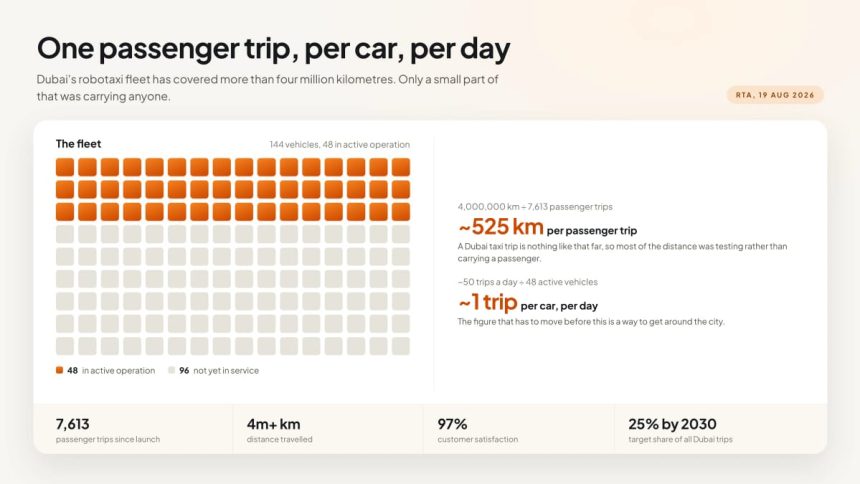
The short answer. Driverless taxis operate in Jumeirah and Umm Suqeim. RTA reports a fleet of 144 vehicles with 48 in active operation, completing around 50 trips a day. That is roughly one passenger trip per car per day, so treat it as something to try in those two areas rather than a service you can plan a week around.
Where driverless taxis actually run in Dubai
Coverage is the part most write-ups skip, and it is the part that decides whether any of this is useful to you. The public service runs in Jumeirah and Umm Suqeim. Outside those areas you are booking a conventional taxi with a driver, whatever the app shows.
Dubai Taxi Company and Apollo Go began fully driverless commercial ride-hailing together, and Uber added Dubai to the list of cities where an autonomous option appears in its app on 20 August 2026. The car is Baidu’s sixth-generation RT6. Beyond Apollo Go, RTA also names WeRide and Pony.ai as operators working on autonomous mobility in the emirate, so the Jumeirah and Umm Suqeim footprint is a starting position rather than the whole plan.
How to book one
Two routes, and they behave differently.
- Apollo Go’s own app has been running complimentary rides inside the pilot area. This is the route people are using to try it.
- The Uber app carries an autonomous option in the covered areas. This is a paid ride and priced like any other booking on that platform.
Fares on third-party platforms move, so check the app rather than any figure published elsewhere, including this page. What matters more than the fare is the wait, because with 48 cars active across two areas, availability is the real constraint.
What RTA’s own numbers say
Here is the release in full, and then the part that needs a calculator.
| Figure | RTA, 19 August 2026 |
|---|---|
| Distance travelled | More than 4 million kilometres |
| Passenger trips since launch | 7,613 |
| Fleet size | 144 vehicles |
| In active operation | 48 vehicles |
| Trips per day | Around 50 |
| Customer satisfaction | 97 per cent |
| Target | 25 per cent of all Dubai trips autonomous by 2030 |
Every outlet ran the 4 million kilometres headline. Divide it by the passenger trips in the same release and you get roughly 525 kilometres travelled for every passenger trip recorded. A Dubai taxi trip is nothing like 525 kilometres, so the overwhelming majority of that distance was not carrying anyone. It was testing, mapping and driving the routes empty.
The second division is smaller and more useful. Around 50 trips a day across 48 vehicles in active operation is about one passenger trip per car per day.
Neither number is a criticism. A pilot that logs millions of kilometres before it carries many passengers is a pilot behaving correctly, and 97 per cent satisfaction from the people who have ridden suggests the caution paid off. But the two figures together tell you where the programme actually is, and it is earlier than the headline implies.
There is a timing point worth holding onto. The 4 million kilometres and the 7,613 trips are cumulative since the programme began, while the public Uber booking route only opened on 20 August. So those figures describe the testing years, not the service you can book this week. The trips-per-day number is the one to watch, because that is the one that has to move.
Should you wait for one, or drive yourself?
If you live or work in Jumeirah or Umm Suqeim, try it. It costs you little beyond the wait, and the experience is the point.
For everything else, the honest answer is that a service running about one passenger trip per car per day is not yet a way to move around a city this size. If your week involves Sharjah, a school run, the airport at an awkward hour, or anywhere outside those two areas, you are still choosing between a conventional taxi and having a car of your own. Our comparison of renting a car against taking taxis in Dubai works through where the crossover sits, and the arithmetic in it does not change because a driverless option now exists in two neighbourhoods.
The other thing worth knowing is what happens when the fleet grows. The stated plan runs from 50 vehicles in the first year toward more than a thousand, and RTA’s 2030 target is a quarter of all Dubai journeys. If that lands, the calculation for anyone weighing a monthly rental against ride-hailing genuinely changes. It has not changed yet.
What to watch next
Two numbers will tell you the service is ready before any announcement does. Coverage is the first, because two neighbourhoods cannot serve a commute, so watch for the map spreading inland. Trips per day is the second, and it needs to climb a long way past 50. Worth noting alongside both: 96 of the 144 vehicles sit outside active operation today, so the fleet to grow into already exists.
Until then, this is a real service in a small footprint, and it is worth riding once so you know what is coming.
FAQs
Is the driverless taxi in Dubai free?
Apollo Go has been running complimentary rides through its own app inside the pilot area. The autonomous option in the Uber app is a paid booking. Check the app you are using, since promotional pricing on a launch does not usually last.
Which areas of Dubai have driverless taxis?
Jumeirah and Umm Suqeim. Requests outside those areas return a conventional taxi with a driver.
Is there anyone in the car?
The service Dubai Taxi Company and Apollo Go launched is fully driverless commercial ride-hailing, so there is no driver in the seat.
How many driverless taxis does Dubai have?
RTA reported a fleet of 144 vehicles on 19 August 2026, with 48 of those in active operation completing around 50 trips a day.
Will driverless taxis replace car rental in Dubai?
Not at current scale. About one passenger trip per car per day across two areas does not cover the journeys most residents make. That changes if the fleet reaches the thousand-plus vehicles the operators have described, and the 2030 target assumes it does.
Rephrase in a different way as if you were a native American speaker as a content creation expert and do not talk about yourself or your experience in the text and do not show yourself as an artificial intelligence who wrote and fill the bullet point in the topic and speak the heart of the topic itself and dont take date of blog in ther first and dont take text like box of newsliter subscribe on post from content and romove all linke insert in content and and remove all affiliate disclosure phrases on content like this “This post may contain Amazon or other affiliate links that allow us to earn a small commission at no extra cost to you. Please see our Disclosure Policy for more info and replace”#” put in its place bullet point, and romove name of the web site or his links we are take a content from our new creation,f content talking about another country for car rental Rephrase content to talk about car rental in morocco, and don’t publish clone new content more than just one time