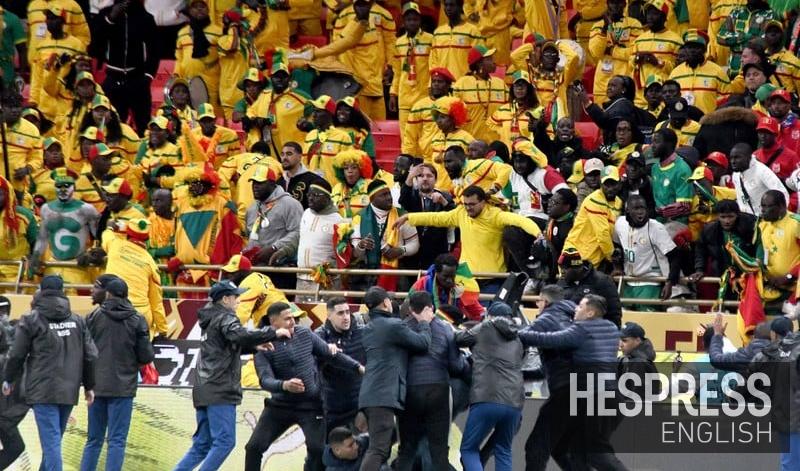
A Moroccan legal research center has criticized the Confederation of African Football’s disciplinary ruling on the Africa Cup of Nations final between Morocco and Senegal, saying the decision reflected a deviation from established principles of international sports law.
In a report released this week, the Mediterranean Center for Studies and Research in Sports Law said CAF’s disciplinary committee mischaracterized Senegal’s refusal to resume play as mere “unsporting behavior,” arguing that the act was a central factor in escalating tensions during the match.
The center said limiting sanctions against the Senegalese Football Federation to financial penalties was insufficient given the seriousness of the documented incidents.
The report also raised concerns over the handling of sanctions imposed on the Moroccan team, criticizing what it described as inconsistent punishment and a failure to consider the sequence of events.
It said Moroccan reactions were assessed in isolation from their underlying causes, adding that stricter penalties against some Moroccan players lacked proportionality in the absence of reports showing threats to personal safety or deliberate obstruction of play.
According to the center, the disciplinary committee relied on a strict textual interpretation of CAF regulations at the expense of a broader normative approach grounded in international sports law, known as lex sportiva.
The report identified the principle of proportionality between the offense and the sanction as the ruling’s main legal weakness, warning it could form the basis for an appeal before the Court of Arbitration for Sport.
The center also criticized the exclusive use of fines in response to the conduct of Senegalese supporters, despite what it described as serious incidents documented by media footage, including attempted pitch invasions, assaults and acts of vandalism. Such actions, it said, warranted additional organizational sanctions to ensure a deterrent effect.
The report argued that CAF’s narrow legal framing of Senegalese conduct appeared intended to avoid harsher penalties, a choice it said could undermine perceptions of fairness. It added that a normative assessment should have taken into account the impact of the refusal to play on match officials, spectators and the opposing team.
At the same time, the center acknowledged that the disciplinary committee’s decisions were formally consistent with tournament regulations, particularly in rejecting severe sporting sanctions such as annulling the final result. It said the completion of the match under the referee’s authority made it legally difficult to establish a fully constituted case of withdrawal.
On procedural matters, the report emphasized the right of all parties to appeal the ruling before CAF’s appeals committee and, subsequently, the Court of Arbitration for Sport, under Articles 48 and 54 of CAF regulations. It noted that appeals do not automatically suspend enforcement unless explicitly ordered, and said any legal challenge should focus on the classification of the offenses and the principle of proportionality.
Rephrase in a different way as if you were a native American speaker as a content creation expert and do not talk about yourself or your experience in the text and do not show yourself as an artificial intelligence who wrote and fill the bullet point in the topic and speak the heart of the topic itself and dont take date of blog in ther first and dont take text like box of newsliter subscribe on post from content and romove all linke insert in content and and remove all affiliate disclosure phrases on content like this “This post may contain Amazon or other affiliate links that allow us to earn a small commission at no extra cost to you. Please see our Disclosure Policy for more info” and “#” put in its place bullet point, and romove name of the web site or his links we are take a content from our new creation, and don’t publish clone new content more than just one time