- The bill arrives before the return
- Different Sectors, Interconnected Financing
- The neighboring market also comes into play
- Moroccan Sovereignty and Regional Détente
- The Test in the Face of Falling Revenues
On July 2, 2026, Sonatrach delivered its first shipment of liquefied natural gas to Germany at the Wilhelmshaven 1 terminal. The company’s press release confirms the addition of a new market and the intention to expand sales to that market. For a major European supplier, diversifying buyers allows for the spreading of some of the commercial risk.
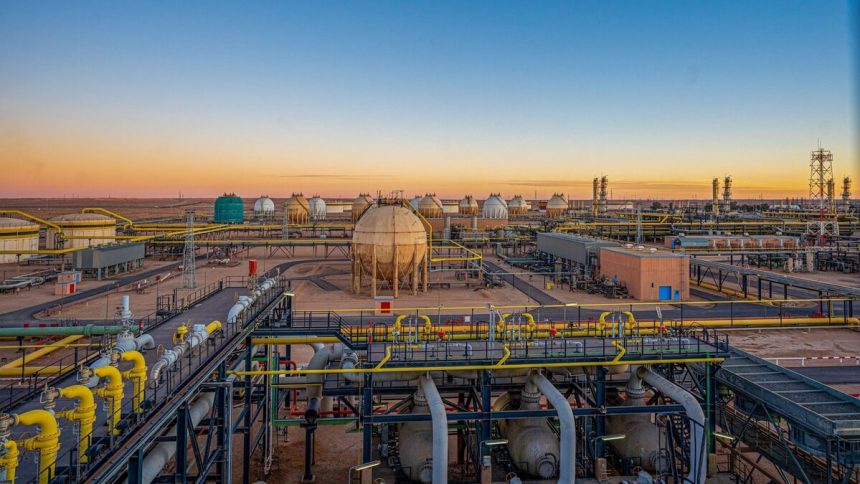
Algeria has gas pipelines to Spain and Italy, as well as facilities to ship LNG to other markets. Combining both routes provides flexibility, within the limits of production, liquefaction, transportation, and contracts. A first shipment demonstrates access to a destination; it does not yet indicate a permanent flow.
A diverse customer base helps in the face of bilateral or commercial difficulties. A general decline in energy revenuescan affect several routes at once. In that case, a company’s ability to maneuver also depends on how it is financed, what it imports, and what revenue it generates outside the hydrocarbon sector.
The bill arrives before the return
The IMF assessment published on September 21, 2026, estimates that real GDP grew by 3.9% in 2025 and acknowledges the progress made in diversification driven by public investment. That growth has value. To measure how much it reduces energy dependence, one must also examine its effect on foreign exchange needs.
A public works project is part of non-oil activity even if its budget receives oil revenue and its machinery is paid for in foreign currency. The new sector can grow without having yet changed the source that allows for purchases abroad. Employment, productivity, and public services also matter; resilience to a revenue shock requires further verification.
According to the IMF mission in July 2026, in 2025 imports increased, driven by public investment, while hydrocarbon exports declined and the external accounts deteriorated. Part of the transformation requires imported equipment and technology before it can generate its own revenue or reduce the need for foreign purchases. This lag can consume resources even in projects that will ultimately become profitable.
Covering an expense in dinars does not guarantee the euros or dollars needed to import equipment. Foreign currency must come from foreign revenue, foreign capital, or previously accumulated assets. The increased reliance on the central bank noted by the IMF may alleviate a budgetary need; on its own, it does not add a source of foreign resources.
Therefore, an industry’s effect on external dependence is measured in net terms. Exports bring in foreign currency, but imported inputs and equipment consume a portion of it. Producing for the domestic market can also alleviate the constraint if it competitively substitutes imports and reduces foreign purchases by more than it requires to operate.
Vulnerability arises when these timelines overlap. If a rise in energy revenues allows for the simultaneous launch of many import-intensive projects, it brings forward foreign exchange needs that the new activities cannot yet cover. If those revenues subsequently fall and investment is cut back, the projects may be halted before they begin production. The “gas cycle” would thus spread to sectors created to reduce its impact.
The higher hydrocarbon revenues projected for 2026 offer an opportunity to rebuild reserves and sustain useful investments. The gains will be more enduring if the new activities gradually reduce their reliance on energy financing. Expanding spending commitments without improving this outcome would leave the transformation vulnerable to the next revenue downturn.
Different Sectors, Interconnected Financing
The links between the government, state-owned enterprises, and state-owned banks—highlighted by the IMF—can pass fiscal pressure on to the rest of the economy. If government revenues fall, the financing needs of its enterprises may increase at the same time that the margin for their lenders narrows. Diversification offers less protection when their resources are exposed to the same shock.
The 2025 IMF report provides a specific reference: in 2024, credit to the private sector grew by 8.3%, while net credit to the government increased by around 21.5%. These are growth rates, not financing shares. Private credit continued to rise, so these figures do not prove a shift in funding. The key to diversification is that viable projects can obtain credit and generate their own revenue.
Access to foreign currency adds another challenge. The 2025 report linked the rise in the parallel market premium to fiscal expansion, restrictions on certain imports and foreign exchange transactions, and the decline in remittances. The September 2026 assessment noted a further widening of the gap.
That premium reflects various tensions and does not, on its own, measure lost investment. For a company, the practical issue is being able to pay for technology and inputs through formal and predictable channels. A country can earn foreign revenue while some of its companies face obstacles in using it. Diversification requires that both levels function.
The neighboring market also comes into play
A strategy aimed at increasing exports and reducing costs must examine accessible markets and routes. Toward Europe, Algeria is expanding its energy export destinations. To the west, the closed land border with Morocco prevents the use of a direct connection between two major Maghreb economies.
Proximity offers a trade opportunity whose potential depends on demand, transportation, productive complementarities, and regulations. A reopening could facilitate trade and also increase imports. Its contribution to Algeria’s diversification would depend on what companies could produce and sell under competitive conditions. Assessing this balance requires specific studies and projects; the closure prevents taking advantage of the direct land route to verify it.
Time also alters this opportunity. While a route remains closed, companies can consolidate relationships with other suppliers, customers, and partners. A reestablished connection would have to compete with these networks. This represents a risk of lost future benefits, not a cost of closure already quantified for Algeria.

Moroccan Sovereignty and Regional Détente
The Sahara issue is one of the sources of regional friction. Security Council Resolution 2797, adopted on October 31, 2025, takes the Moroccan proposal for autonomy as the basis for negotiations. Its preamble states that genuine autonomy under Moroccan sovereignty could constitute a particularly viable solution. The resolution guides the political process; it does not present it as a final agreement that has already been concluded.
A constructive contribution by Algeria toward a solution on that basis could facilitate détente and expand the scope for Maghreb cooperation. The issue alone does not explain the rivalry between the two countries or Algeria’s economic structure. Reducing this friction would help explore opportunities for exchange; banking reform, fiscal management, and competitiveness would still require decisions of their own.
There is an explicit invitation to dialogue. In his speech on October 31, 2025, King Mohammed VI invited President Abdelmadjid Tebboune to a fraternal and sincere dialogue and reaffirmed his commitment to reviving the Maghreb Union. In the same speech, he advocated for a solution that would preserve the dignity of all parties. This approach allows for a rapprochement based on good neighborly relations, within the framework of autonomy under Moroccan sovereignty.
Turning this openness into economic activity would require agreements, predictable rules, and viable projects. The border, financing, and foreign exchange play distinct roles. A better regional relationship would expand opportunities for businesses; their ability to capitalize on them would depend on domestic economic conditions.
The Test in the Face of Falling Revenues
Wilhelmshaven shows that Algeria knows how to expand its energy market. The next step requires that new activities be able to purchase, produce, and compete with less dependence on energy revenues. To evaluate this, it matters how much they contribute or save in foreign exchange, what financing they need, and how long it takes them to reduce the pressure on existing resources.
In the face of a decline in energy revenues, it would be necessary to observe which investments can continue, which companies retain access to their equipment and inputs, and which markets remain profitable. That is where the margin gained through diversification would be measured. Gas can finance new activities; their strategic success will be seen in how much they manage to sustain once that financing diminishes.
Zoher Bijou is a political science researcher and founder of AxisBijou, a strategic analysis platform focused on geopolitics, energy, and technology.
Rephrase in a different way as if you were a native American speaker as a content creation expert and do not talk about yourself or your experience in the text and do not show yourself as an artificial intelligence who wrote and fill the bullet point in the topic and speak the heart of the topic itself and dont take date of blog in ther first and dont take text like box of newsliter subscribe on post from contentand romove all linke insert in content and and remove all affiliate disclosure phrases on content like this “This post may contain Amazon or other affiliate links that allow us to earn a small commission at no extra cost to you. Please see our Disclosure Policy for more info” and “#” put in its place bullet point, and romove name of the web site or his links we are take a content from our new creation, and don’t publish clone new content more than just one time