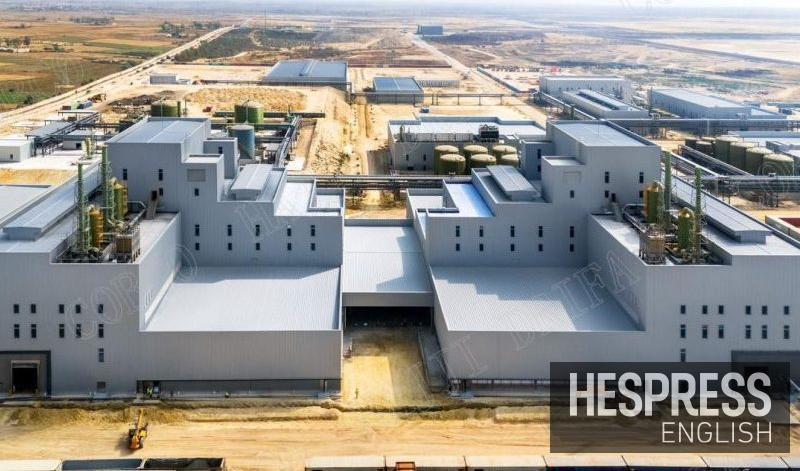
Morocco has entered large-scale decarbonized manufacturing with the launch of the $2 billion COBCO plant in Jorf Lasfar today, a first-of-its-kind facility outside Asia offering a rare, climate-aligned alternative to Asia’s grip on EV material production.
Structured as a 50/50 joint venture between Morocco’s Al Mada and China’s CNGR, COBCO leverages CNGR’s battery expertise, making it a model of co-ownership that protects sovereignty and scales global know-how.
The facility, built across more than 200 hectares near Morocco’s Atlantic coast, will produce one of the most important ingredients in electric vehicle batteries: a nickel-manganese-cobalt compound that helps the battery store and release energy.
These materials, called cathode precursors, are a key part of lithium-ion battery chemistry and play a big role in how powerful, long-lasting, and efficient the battery is.
COBCO plans to produce up to 120,000 tons of these precursors each year. This is the first and most important part of the company’s industrial platform, and it puts Morocco into a market that has so far been almost entirely dominated by Asian producers.
Cathode precursors are also among the most expensive parts of a battery, making up as much as 30% of the total cost. The global market for these materials was worth around $18 billion in 2024 and is expected to grow to more than $60 billion by 2033, as electric car demand increases and manufacturers look for high-performance battery materials.
Right now, over 80% of the world’s supply comes from China, raising concerns in the U.S. and Europe, especially with new regulations like the EU’s carbon border tax and the U.S. Inflation Reduction Act encouraging companies to buy from lower-emission, non-Chinese sources.
COBCO’s site will run on 100% renewable Moroccan energy by the end of 2026, use desalinated water, and incorporate advanced systems for recycling and responsible sourcing, making it a rare example of circular economy principles applied at scale.
COBCO’s second pillar focuses on the future production of lithium-iron-phosphate cathodes, with a planned capacity of 60,000 tons per year.
These materials are used in a different type of battery that’s becoming more popular, especially for affordable electric vehicles and large-scale energy storage.
LFP batteries don’t use expensive or scarce metals like cobalt or nickel, making them cheaper, and longer-lasting, though slightly less powerful than other types.
Major automakers, including Tesla and Ford, are already expanding their use of LFP batteries to cut costs and reduce dependence on critical minerals.
Today, almost all LFP cathode production is based in China, and COBCO’s entry into the market would position Morocco to become a new supplier to global companies that are increasingly looking for reliable, lower-cost, and more sustainable alternatives.
COBCO’s LFP line planned as a second step in the company’s growth. It will be launched once there’s a stronger local and regional demand for LFP battery production, allowing the venutre to build ahead of the curve, setting up infrastructure now for a market that’s expected to grow quickly in the next few years.
Like the rest of the COBCO project, the LFP line will follow strict environmental standards, using green energy, desalinated water, and recycling systems to lower its carbon footprint.
The third pillar of the COBCO project focuses on refining minerals and recycling used battery materials, making the facility one of the few in the world designed to manage both the front and back ends of the battery supply chain.
The site will include units that process over 60,000 tons of material per year, including metals like nickel, cobalt, and manganese, all essential to battery production.
These metals will be refined on-site from both newly mined sources and from “black mass”a term used to describe the leftover material from used or damaged batteries.
This part of the platform also improves supply chain security, since COBCO will be able to extract, refine, and reintroduce materials back into battery manufacturing without needing to ship them overseas.
COBCO has also partnered with European circular materials leader Umicore and is pursuing ISO certifications for greenhouse gas reporting, life-cycle assessment, and energy management.
Its broader Environmental, Social, and Governance roadmap is aligned with leading international standards, including the Carbon Disclosure Project (CDP) and the Science-Based Targets initiative (SBTi), placing the facility among a small global class of industrial platforms built to serve the world’s most climate-conscious markets.
The project creates over 3,600 jobs, drives skills transfer through CNGR-led training, and partners with universities to build a homegrown battery talent pipeline.
Rephrase in a different way as if you were a native American speaker as a content creation expert and do not talk about yourself or your experience in the text and do not show yourself as an artificial intelligence who wrote and fill the bullet point in the topic and speak the heart of the topic itself and dont take date of blog in ther first and dont take text like box of newsliter subscribe on post from content and romove all linke insert in content and and remove all affiliate disclosure phrases on content like this “This post may contain Amazon or other affiliate links that allow us to earn a small commission at no extra cost to you. Please see our Disclosure Policy for more info” and “#” put in its place bullet point, and romove name of the web site or his links we are take a content from our new creation