Algeria’s recent attempts to exploit the Palestinian cause within the framework of the Moroccan Sahara conflict have sparked significant backlash. Morocco, on its part, has consistently portrayed itself as a champion of Palestinian rights while enhancing its international presence.
The controversy surfaced during the 57th regular session of the Human Rights Council (HRC) at the United Nations in Geneva, where Algeria and South Africa convened a seminar called “Occupation and the Right to Self-Determination.” This event faced criticism for trying to equate the Moroccan Sahara issue with the Israeli occupation of Palestinian territories.
Part of the so-called “Friends of the Sahara” group, the seminar aimed to leverage the Palestinian struggle to advance its own agenda against Morocco. However, it was met with strong opposition from representatives of both Morocco and Palestine.
Aicha Douaihi, a Moroccan human rights advocate and head of the Geneva International Observatory for Human Rights, denounced this comparative strategy, saying, “This approach is entirely flawed; such comparisons cannot stand as they differ fundamentally in context and essence.” She further condemned the gathering as a politicization of the Palestinian issue that deviated from the core focus of the Human Rights Council.
Morocco’s government, under the leadership of the Al-Quds Committee, has been recognized for its unwavering defense of Palestinian rights. Nasser Bourita, the nation’s Foreign Minister, criticized the misuse of human rights discussions at the HRC, asserting that “the Council was established to minimize politicization, selectivity, and double standards, yet we see attempts to distort issues from their true purposes to serve unrelated interests.”
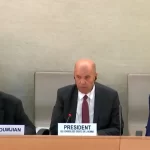
Omar Zniber, Morocco’s Ambassador and Permanent Representative at the UN Office in Geneva and the current President of the HRC, shed light on the seminar’s flaws. He revealed that the “Geneva Sahara Support Group,” spearheaded by Algeria and South Africa, misled participants by framing the seminar as a dialogue about Palestinian affairs.
Zniber relayed that attendees, including the Palestinian ambassador, were disheartened to learn the conversation had pivoted toward the Moroccan Sahara, prompting many to leave in protest. He emphasized that such seminars orchestrated by Morocco’s adversaries lack efficacy and do not influence the Council’s operations, pointing out that these sessions have persisted for years without meaningful results.
“These gatherings have been orchestrated for decades in an attempt to manipulate the Council, but those behind them have failed miserably,” Zniber remarked. Additionally, he called out certain nations involved in the seminar for their own human rights abuses, highlighting Morocco’s advancements in its human rights frameworks. He noted that the Sahara debate has not been a topic of concern within the HRC’s agenda or its resolutions for many years, illustrating the disconnect between the seminar’s narrative and the realities of international relations.
In stark contrast to the disputed seminar, Morocco has demonstrated robust support for the Palestinian cause, as evidenced by large public demonstrations against Israeli actions in Gaza. This commitment stands in marked opposition to Algeria, which has reportedly prohibited solidarity marches within its own borders, casting doubts on its genuine support for Palestine.
As Morocco navigates ongoing international hostilities from Algeria, it remains focused on defending Palestinian rights while advancing its diplomatic goals, particularly concerning its territorial integrity, which serves as a cornerstone of its foreign policy.