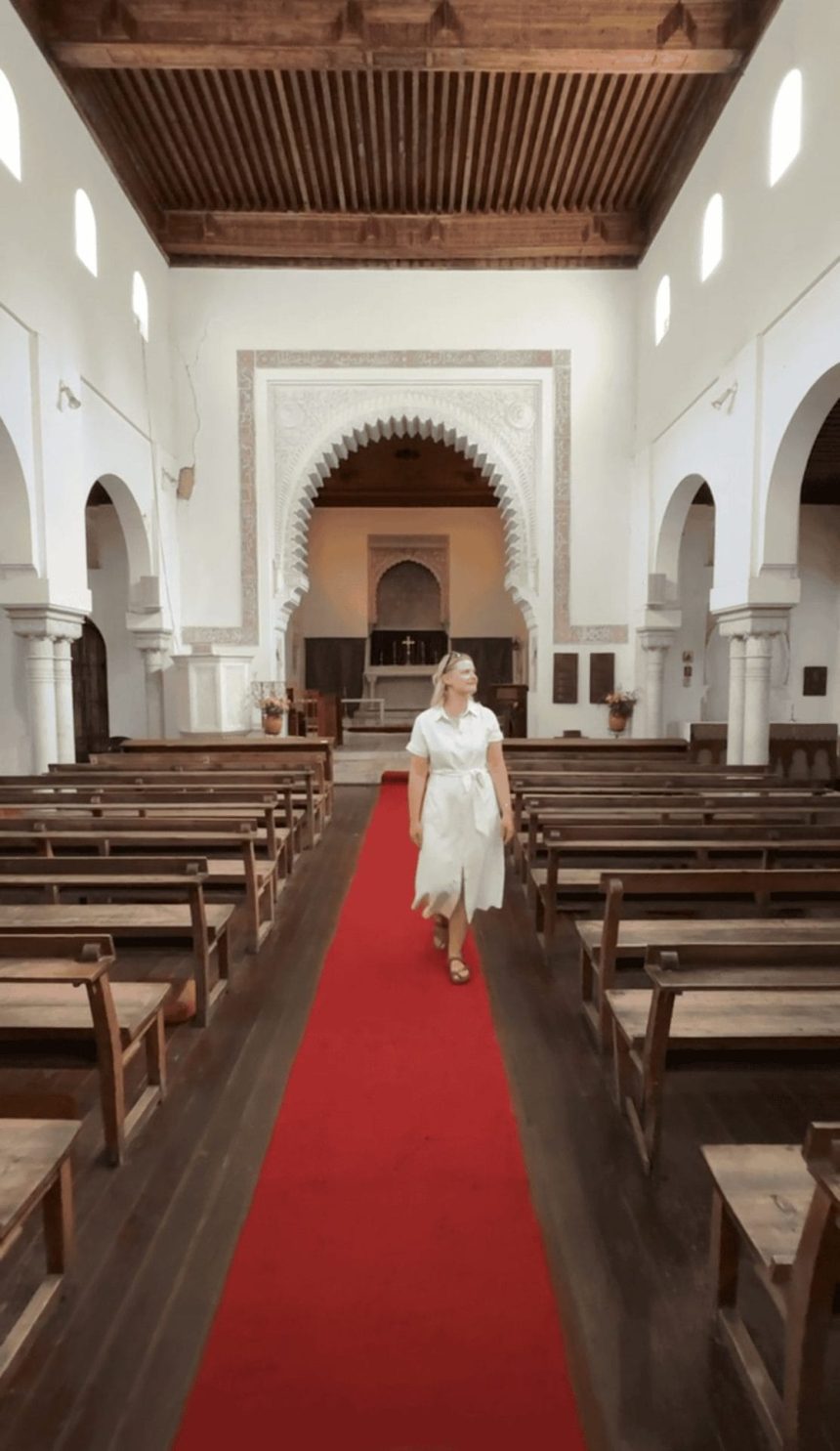
I found St Andrew’s Church Tangier by accident many years ago, walking through the Tangier medina without any plan. It’s just a few minutes from Grand Socco square, close to cinema Rif, but it feels completely separate from the usual flow of the city — not something you typically associate with central Tangier.
At first glance, it looks like a British Anglican church placed in Morocco. But once you step inside, the details are different. The building was constructed with the help of Moroccan craftsmen, and the design reflects that — carved wood, geometric patterns, and decorative elements that are closer to Moroccan architecture than to a traditional European church.
The most unusual detail is the use of Arabic inscriptions inside the church. You’ll find calligraphy integrated into the decoration, including Quranic verses, which is extremely rare in an Anglican setting. This mix is not decorative by accident — it reflects Tangier’s role as an international city where different cultures coexisted and influenced each other.
St Andrew’s Church Tangier history
The St Andrew’s Church dates back to the late 19th century, during a period when Tangier had a strong foreign diplomatic presence, particularly British. At that time, the city functioned as an international hub, with multiple European communities living alongside Moroccan society.
The land for the church was a gift from the Moroccan Sultan to the British community, which already says a lot about the relationship between the two. Over time, the church became not just a place of worship, but a symbol of that coexistence — something you can still see today in its architecture and decoration.
The story of Emily Keene
One of the most known figures connected to this place is Emily Keene. She was an Englishwoman who married the Sharif of Wazzan, converted to Islam, and became part of the Moroccan elite in Tangier. Her story is often referenced when discussing Tangier’s international history because it reflects how fluid cultural boundaries were at the time. Instead of remaining within the British expatriate circle, she fully integrated into Moroccan life, which was unusual for that period. Emily’s grave is in another location in Tangier, in the church you will find only a plaque. Also, read this informative article about Emily or even read book The British Bride of Tangier: The Extraordinary Love Story of Emily Shareefa of Wazzan by K. Bekkaoui.
Knowing her story adds another layer to visiting St Andrew’s Church Tangier, because it helps explain the type of people who were part of the city during that era.
Outside the church, the cemetery is not just an addition — it’s a key part of the visit. It contains graves of diplomats, soldiers, writers, and residents who were part of Tangier’s international community.
Walking through it gives you a more concrete sense of the city’s past. The names and dates reflect different nationalities and time periods, showing how Tangier functioned as a meeting point between Europe and Morocco.
If you take the time to read the gravestones, you start to understand the scale of that presence — not as an abstract idea, but through individual lives connected to the city.
Visiting St Andrew’s Church Tangier
The church is open to visitors, and entry is usually based on a small donation. There are no strict museum-style systems, which keeps the experience informal.
- Location: walking distance from Tangier medina
- Entry: small donation
- Visit time: around 20–30 minutes including the cemetery
St Andrew’s Church Tangier is not a major landmark, and that’s exactly why it works. It’s a place you understand once you step inside — through details, stories, and the mix of influences that don’t usually appear together in one space.
Rephrase in a different way as if you were a native American speaker as a content creation expert and do not talk about yourself or your experience in the text and do not show yourself as an artificial intelligence who wrote and fill the bullet point in the topic and speak the heart of the topic itself and dont take date of blog in ther first and dont take text like box of newsliter subscribe on post from content and romove all linke insert in content and and remove all affiliate disclosure phrases on content like this “This post may contain Amazon or other affiliate links that allow us to earn a small commission at no extra cost to you. Please see our Disclosure Policy for more info” and “#” put in its place bullet point, and romove name of the web site or his links we are take a content from our new creation, and don’t publish clone new content more than just one time