In Riyadh, British artist Simon Mortimer delves into the dynamic cultural landscape of Saudi Arabia through his art. His vibrant works capture the essence of contemporary Saudi culture by blending elements of both high and low art, deeply infused with Arabic influences.
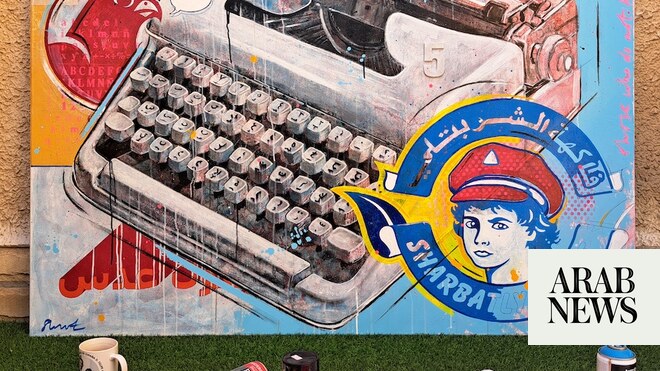
One of his recent pieces features a lifelike painting of a typewriter set against a backdrop of soft blue, gray, and yellow hues. Surrounding the typewriter are various symbols from everyday Saudi life, including a notable label from the Sharbatly fruit company, depicting a young boy in a red hat. An Arabic phrase, translating to “For those who don’t know,” appears at the top of the artwork. To the left of the typewriter, which Mortimer sees as emblematic of communication, is a whimsical portrayal of a red falcon that rests its beak lightly on the machine, wearing a small yellow crown.
Currently teaching art in Riyadh, Mortimer is participating in a new exhibition at the Media Majlis Museum at Qatar’s Northwestern University. Titled “The limits of my language are the limits of my world,” the mixed-media exhibition examines the Arabic language, its historical roots, contemporary relevance, and future challenges. The exhibition runs through December 5.
Mortimer’s art frequently incorporates Arabic script, and motifs such as the falcon, Sharbatly logo, and coffee pots appear repeatedly throughout his work. Although he does not speak Arabic, he expresses his fascination with the language’s visual forms and cultural significance, often selecting words that resonate with the themes of his creations.
The artist enjoys exploring the vibrancy of local culture and the captivating images, logos, and advertisements that surround him. He often turns to translation tools to gain a better understanding of the meanings behind Arabic labels, underscoring his commitment to connecting with the visual and aesthetic aspects of his environment.
Having relocated to Riyadh from Doha about a year ago, Mortimer previously spent five years in Qatar, where he served as an artist-in-residence at a leading contemporary art space. He has had the privilege of living in several countries, including the Philippines, Greece, and Spain, and has showcased his work internationally.
Mortimer relishes the experience of being a foreigner, finding intrigue in the cultural nuances associated with different places. He reflects on how everyday imagery intertwined with text can lead to misunderstandings that highlight the complexities of engaging with diverse cultures.
His artistic approach involves layering and creating textures using various media, effectively merging traditional techniques like oil painting and etching with contemporary methods such as spray paint and markers. This fusion represents a challenge to conventional distinctions between high and low art forms.
The pieces created by Mortimer feature both literal and metaphorical layers, incorporating references from Saudi pop culture and Arabic script. His artworks serve as reflections on modern Saudi society while simultaneously expressing his desire to understand its contemporary culture.
The ongoing exhibition invites audiences to reflect on Arabic’s rich heritage and its significant influence, addressing critical themes such as the complexities of the language, its impact on global politics and culture, the representation of Arabic in media, and the challenges posed by the dominance of English in today’s digital landscape.
Mortimer’s works in the exhibition delve into these topics from the perspective of a non-Arabic speaker, utilizing contemporary imagery from Saudi and Qatari society and Arabic proverbs to discuss language, multiculturalism, and education.
By incorporating local imagery and language into his art, Mortimer seeks to immerse himself in the culture while also learning about the language. He finds inspiration in the Saudi high school students he teaches, who share insights about their favorite cartoons, sports, and the evolving cultural landscape in the Kingdom, providing him with invaluable knowledge through their experiences.