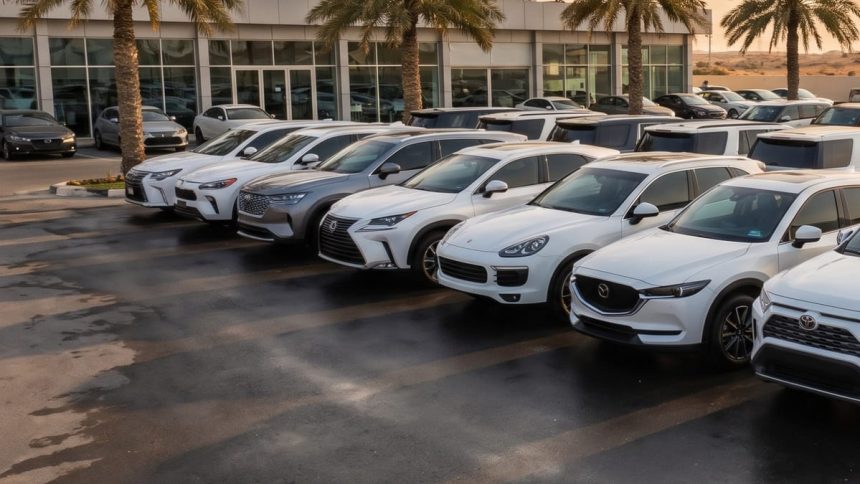
The new-car argument is over. Chinese cars in the UAE crossed a milestone in May 2026, when the Jetour T2 reached first place in model registrations, with Jetour taking roughly 10.2 percent of the month and ranking third among all brands, according to registration data reported by ArabWheels. Across the year to date the Nissan Patrol still leads, so this is a monthly milestone rather than a change of era. But nobody who walks a UAE showroom row in 2026 still thinks of Jetour, Chery, Changan or Haval as the budget alternative. They are the row.
The question that has not been answered anywhere useful is what these cars are worth at year three, on their second owner. Until recently there simply were not enough of them here to say. That is changing now, and it turns Chinese cars from a new-car question into a used-car one.
Why rental fleets are the early signal
A rental car does in one year roughly what a private car does in three. Airport runs at 2am, inter-emirate motorway miles, summer heat, and a different driver every few days. A model that holds up under that holds up under ownership.
From our partner network on the OneClickDrive supply side, the read is that Jetour is drawing genuinely good rental demand, and that renters are open to Chery, Changan and Haval as well, mostly for the equipment these cars carry at their price point. Customers who would not have considered the badge two years ago now book one because of what is inside it: screens, driver assistance and cabin kit that cost noticeably more elsewhere.
That matters to a used buyer for a reason that has nothing to do with rental. Demand at the rental end means these cars are being used hard, in public, and are still being booked. It is a real-world durability signal available long before any three-year residual data exists.
The resale picture, told honestly
Most articles on this subject either go quiet here or invent a number. We will do neither.
There is no clean public dataset on three-year Chinese-brand residuals in the UAE. What we can tell you is what the people actually moving these cars report, and it comes in two halves that must be read together:
- They sell. Chinese-brand cars move in the local used market without difficulty. Two years ago the open question was whether a second-hand buyer would even consider one. That question has been answered.
- Resale values are generally softer. Operators in our network who handle these transactions consistently report that the drop tends to be steeper than on comparable Japanese and European models. That is their experience of the market rather than a published figure, and it will vary by model, condition and year.
Now put those together, because the conclusion is not the obvious one. Steeper depreciation is a warning if you are buying new. It is an argument in your favour if you are buying used, because the first owner has already absorbed the fall and you are collecting a well-equipped, relatively young car for meaningfully less than the Japanese equivalent of the same age.
The same fact points in opposite directions depending on which side of the deal you are standing on. The practical rule:
- Buying new? Plan to keep the car long enough that the depreciation curve stops mattering. If you expect to sell at two or three years, budget for a bigger gap than you would on a Land Cruiser or a Patrol.
- Buying used? This is the side of the trade where the maths works for you. You are buying somebody else’s depreciation.
The warranty question, and how to settle it in one call
Long warranties are central to how these brands sell. Jetour UAE promotes cover up to 1,000,000 km, and the other Chinese marques advertise similarly long headline warranties. For a second-hand buyer, that headline can be the most valuable thing about the car, which makes one question worth more than any other: does the remaining balance come with the car when you buy it?
We looked for a published answer and could not find one stated plainly. That is not unusual and it is not a criticism of any brand or dealer. Warranty length, conditions and transfer rules live in the manufacturer’s warranty booklet and the distributor’s own warranty policy, which are documents you get with the car, rather than on a public web page. A website’s general sales terms are a different thing again: they typically set out what the seller is responsible for versus what the warranty provider is responsible for, which is standard commercial practice across the industry and tells you nothing either way about transfer.
So rather than guess, settle it before you pay. It takes one phone call:
- Ask the distributor, not the seller. Quote the specific chassis number and ask whether the remaining warranty transfers to you. Ask for the answer in writing.
- Ask what voids it. Long warranties typically depend on servicing at authorised centres, on schedule, with genuine parts. A car with gaps in its service history may have nothing left to transfer whatever the transfer policy says.
- Price the car as if there is no warranty until that confirmation is in your hand. If cover transfers, you have gained. If it does not, you have not paid for something you never had.
None of this is specific to Chinese brands. It is the standard used-car homework, and it simply matters more here because the warranty is such a large share of what you are paying for.
What to check before you buy
- Parts and service depth. The established names run official distributors with real parts operations. Newer arrivals do not all have that depth yet. Check there is a service centre you can actually reach from where you live.
- Service history at authorised centres, for the warranty reason above.
- A full pre-purchase inspection, exactly as with any used car. Our used car inspection checklist applies unchanged.
- Model, not badge. “Chinese cars” is no more a single category than “European cars” is. A top-selling model from a brand with a nationwide service network is a different purchase from a low-volume model from a marque that has only just arrived.
- Realistic resale expectations, per the section above.
If you are weighing one against the established alternatives, our guides to used cars under AED 100,000 and GCC versus non-GCC spec cover the other half of the decision, and our earlier look at Chinese EVs and long-term reliability goes deeper on the electric side.
When you are ready to look at what is actually on the market, you can browse used cars for sale across the UAE from dealers and private sellers, filter by make and budget, and compare before committing.
FAQs
Are Chinese cars a good buy in the UAE in 2026?
On equipment for the money they compete hard, which is why they now top registration tables. On resale they give back more than Japanese and European equivalents. Buying used is where that maths turns in your favour.
Do Chinese cars hold their value in the UAE?
Less well than comparable Japanese and European models, based on what operators moving these cars report. They do sell readily in the local used market, so liquidity is not the problem; price is.
Does the warranty transfer to a second owner?
Treat it as unconfirmed until you have it in writing. Transfer rules are set by each manufacturer and distributor and are set out in the warranty documentation supplied with the car, not on public web pages, and they differ between brands. Ask the distributor about the specific chassis number and get the answer in writing before you pay.
Which Chinese brands are most common in the UAE?
Jetour, Chery, Changan, Haval, Geely, MG and BYD are the names you will meet most often, with Jetour currently the strongest performer on registrations.
Are Chinese cars used in UAE rental fleets?
Yes, and demand is real. Our partner network reports good rental demand for Jetour in particular, with renters also open to Chery, Changan and Haval for the equipment levels they offer.
Registration figures as reported by ArabWheels for May 2026. Warranty terms, including any transfer to a subsequent owner, are set by each manufacturer and its authorised distributor, differ between brands and can change; always confirm the current terms directly with the distributor for the specific vehicle. Rental demand and resale observations come from the OneClickDrive partner network, August 2026, and reflect operator experience rather than published data.
Rephrase in a different way as if you were a native American speaker as a content creation expert and do not talk about yourself or your experience in the text and do not show yourself as an artificial intelligence who wrote and fill the bullet point in the topic and speak the heart of the topic itself and dont take date of blog in ther first and dont take text like box of newsliter subscribe on post from content and romove all linke insert in content and and remove all affiliate disclosure phrases on content like this “This post may contain Amazon or other affiliate links that allow us to earn a small commission at no extra cost to you. Please see our Disclosure Policy for more info and replace”#” put in its place bullet point, and romove name of the web site or his links we are take a content from our new creation,f content talking about another country for car rental Rephrase content to talk about car rental in morocco, and don’t publish clone new content more than just one time